November 4, 2026 · 6 min read
Coordination Compression
When AI Connects the Work but Disconnects the Human
A person opens an email, finds the relevant project, retrieves the current documents, compares them with the last update, decides what has changed, drafts a response, and records the next action. Every application in that sequence may work well. The person still supplies the continuity between them.
For much of everyday digital work, humans have been the conveyor belts between our systems. We find information, interpret one tool’s output, compare sources, decide what matters, and determine what the next tool should do. The report is visible. The connecting work behind it is less obvious.
AI can coordinate more of that intermediate work. My concern is not simply whether it can make the sequence faster. It is what people acquire while participating in the sequence, and how workflow design can preserve the understanding needed to direct and evaluate it.
What coordination compression changes
Coordination automation predates generative AI. Workflow engines, APIs, enterprise systems, and robotic process automation have connected operations for years. The connective layer is not newly automatable in every setting.
The expanding capability is that a language model can participate in interpreting an objective and selecting permitted intermediate actions. Anthropic’s distinction between predefined workflows and agents that dynamically direct their process is useful here (Anthropic, 2024). Actual implementations vary, and many combine fixed steps with model-directed choices.
One process might follow a prescribed sequence while using a model to interpret a document. Another might allow the model to decide which permitted source to consult next. Those designs delegate different amounts of discretion, even if both are marketed as agents.
I use coordination compression as a framing for the reduction in required human connecting activity. A sequence that once required repeated human handoffs can become one delegated objective followed by fewer review points. I am not claiming to have originated the term.
Where should AI take over, and where should people stay involved?
Traditional workflow
- Human
- System
- Human
- System
- Human
- Outcome
Humans coordinate the transitions between tools and tasks.
AI-coordinated workflow
- Human intention
- AI-coordinated process
- Human review
- Outcome
AI can coordinate more of the intermediate work.
The question is not simply how many steps AI can remove. It is which forms of human participation create understanding, judgment, and accountability.
The steps may move inside an automated process rather than disappear. Sources still have to be found, versions compared, meaning interpreted, and actions selected. Fewer visible handoffs do not mean fewer underlying operations or decisions.
Compression can be useful. An employee might spend less time assembling an update and more time discussing what it means. A small team might complete work that previously exceeded its capacity. The design choice is which effort to remove and which participation to retain or improve.
What people acquire while connecting the work
Research, analysis, comparison, drafting, revision, and decision-making can produce more than a deliverable. Research can sharpen critical thinking and problem framing. Comparing evidence can develop contextual judgment and method selection. Drafting and revising can expose patterns, build domain intuition, and reveal where an explanation does not hold together. Responding to feedback can develop adaptability.
These are opportunities, not guaranteed outcomes. Repeated copying or avoidable reformatting may teach very little. Learning does not require preserving inefficient work. An experienced employee and a newer colleague may also acquire different things from the same activity.
Implicit learning means acquiring patterns or knowledge without deliberate awareness. Tacit knowledge is experiential understanding and judgment that can be difficult to articulate. They are related but not interchangeable: one describes how learning can occur, while the other describes a kind of understanding people may develop.
The Human Work That Builds Expertise
Research
Critical thinking and problem framing
Analysis and comparison
Contextual judgment and method selection
Drafting and revision
Pattern recognition and domain intuition
Decision-making and feedback
Adaptability
Potential learning opportunities, not automatic outcomes of manual work.
AI assistance can support these capabilities when it invites people to compare alternatives, inspect evidence, revise an explanation, and receive feedback. The potential loss arises when the workflow removes those opportunities without providing another way to build the understanding they supported.
Useful consistency and meaningful variation
Imagine ten project managers given the same assignment. This is a thought experiment, not research evidence. Different experiences could lead them to notice different problems, consult different sources, and propose different approaches.
AI assistance can preserve those differences when people actively shape the process: choosing context, challenging assumptions, testing methods, and deciding what deserves attention. Using the same AI system does not inevitably produce identical results.
A standardized automated workflow may narrow meaningful variation when it predetermines sources, assumptions, methods, and decision rules. The concern is not consistency itself. Shared standards can reduce errors and improve reliability. Some variation is error; some enables discovery. The question is whether the process leaves room to recognize when the standard approach is inappropriate.
Ten project managers, one assignment
Human-shaped approaches
Ten people bring different experiences to the same project.
- Notice different problems
- Consult different sources
- Choose and challenge methods
- Shape AI assistance with their own judgment
Standardized automated workflow
Ten people use a process with predefined choices.
- Shared sources and assumptions
- Prescribed methods and decision rules
- Consistency in routine operations
- Variation depends on where people can intervene
Potential risk: fewer opportunities for distinct interpretations and methods
These are potential consequences of design choices, not inevitable outcomes of automation. A workflow can combine reliable routine operations with deliberate opportunities for people to investigate exceptions and propose alternatives.
Participation, review, and delegated authority
Before connecting a process, define what the system may access, what it may change, and which decisions require approval. Reading a project folder is different from updating an official record. Drafting a response is different from sending it.
The email example makes the distinction concrete. Copying a date into a tracker may be repetitive. Recognizing that the date is a provisional milestone, not a replacement for an approved commitment, requires contextual judgment. Automating the transfer without preserving that distinction changes the meaning of the record, even if the transfer succeeds.
Process separation
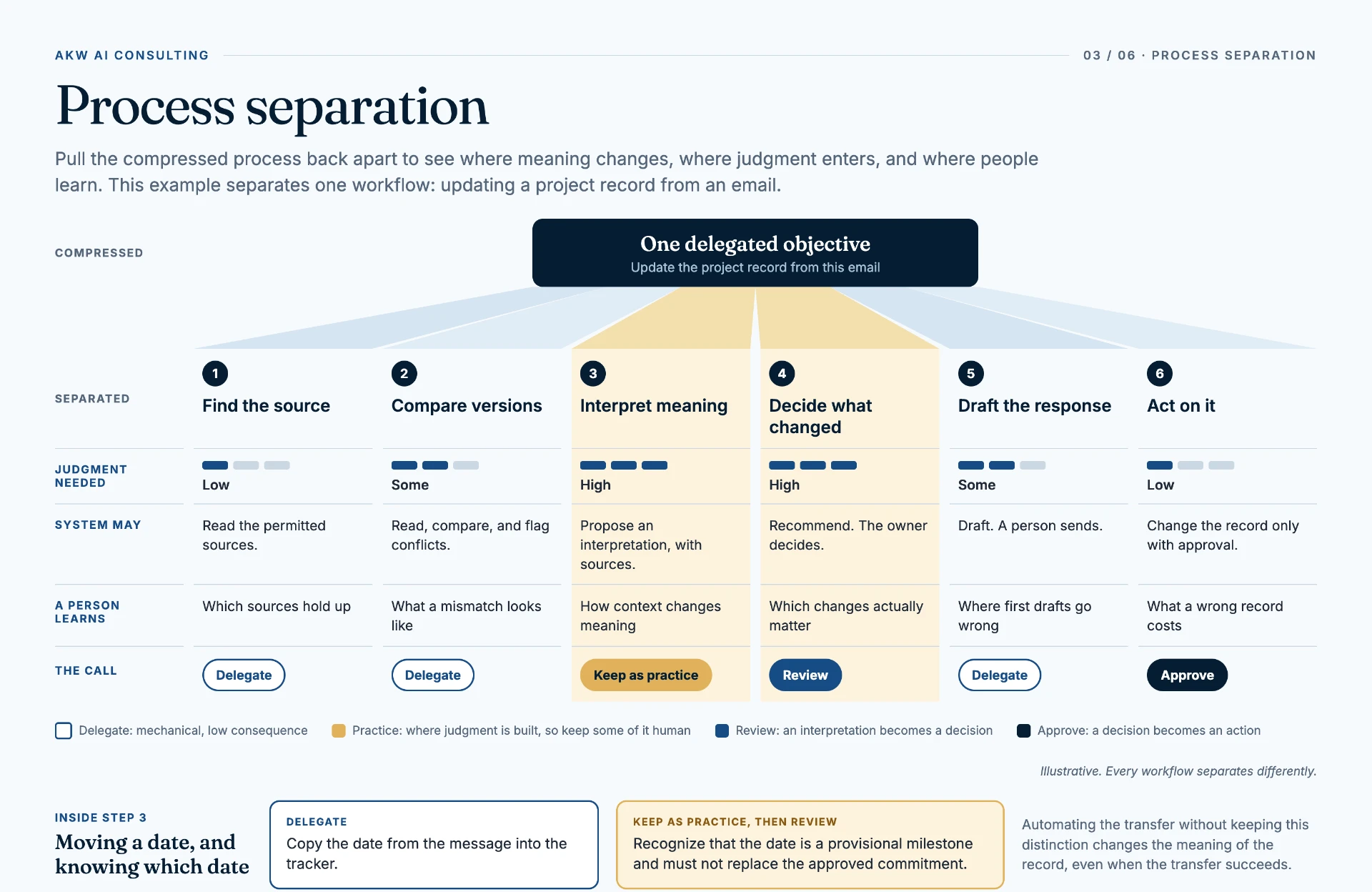
Make sources, substantive changes, and consequential interpretations reviewable. Finding a source, interpreting it, and turning it into a recommendation are different operations. An early error can influence later steps while disappearing inside a coherent final document. A record of relevant sources and meaningful changes may be more useful than a long transcript of every interaction.
Ask: Which steps should people continue to participate in because that participation builds the understanding needed to evaluate the result? Keeping someone at the final approval point is not enough if the process has removed their opportunity to understand what they are approving.
Review requires sufficient understanding, time, information, and authority to challenge an output. The reviewer needs access to relevant evidence and assumptions, space to investigate uncertainty, and the ability to stop or change the process. A review point without those conditions can become a formality rather than meaningful oversight.
Test the handoffs against ordinary failures. A source may be missing. Two documents may disagree. A permission may prevent access. The correct behavior may be to stop and ask, rather than fill the gap with a plausible answer. Assign an owner who can change the workflow’s boundaries and respond when something goes wrong.
The design choice
For implementation, inspect the connections between tools as carefully as the tools themselves. Those connections are where information changes meaning, authority passes, and responsibility becomes real. Automate repetition where it adds little value, improve the work that develops expertise, and make consequential transitions visible and challengeable.
The question is not simply how many steps AI can remove. It is which forms of human participation create understanding, judgment, and accountability, and how we preserve them as more of the work becomes automated.
Written by Amanda Wion, AKW AI Consulting.